
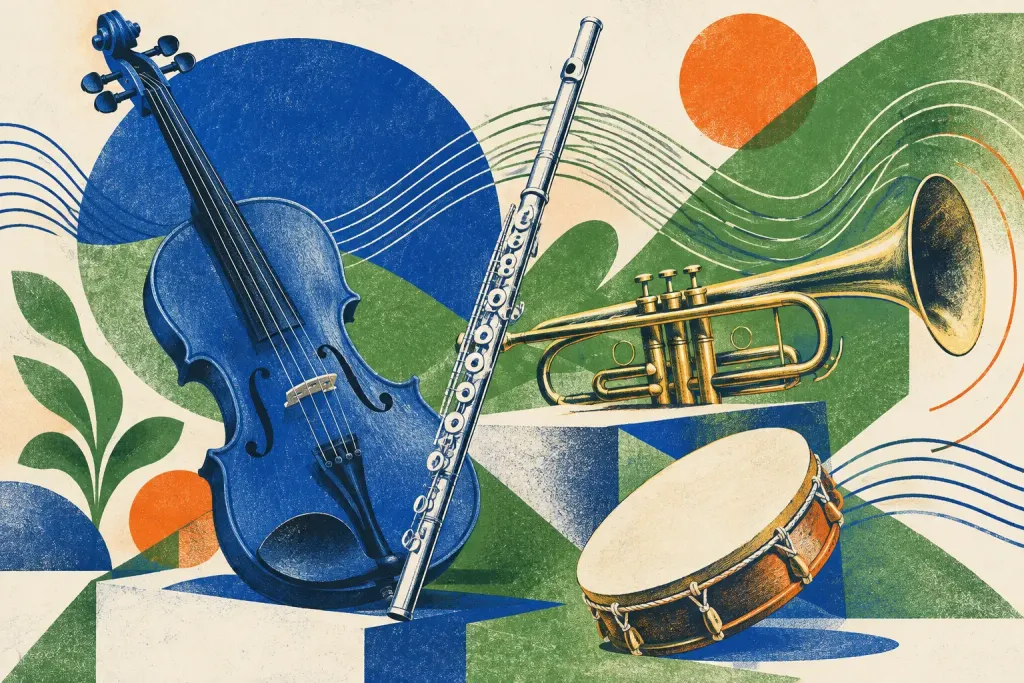
When an orchestra plays together, identifying every instrument can feel like trying to follow every conversation in a crowded room. Start more broadly. Can you notice a family of sounds, then pick out one voice within it?
Carnegie Hall’s Link Up material introduces four orchestral families: strings, woodwinds, brass and percussion. It connects those groups with the instruments’ characteristics and the ways they produce sound. The categories provide a useful beginning, rather than a shortcut that answers every listening question.
Give your attention one job
Choose a short passage from a recording you can lawfully play. On the first listen, simply notice where your attention goes. On a second listen, focus on one sound: something sustained, something sharply attacked, or something that seems to answer another line.
Use ordinary descriptive words before reaching for a name. “A short, bright sound near the end” is a better starting note than confidently labelling an instrument you have not identified. You can compare your impression with the performer credits or a reliable instrument demonstration afterwards.
Connect the sound with its source
Look at a picture or demonstration of the instrument you are exploring. What vibrates? Is it bowed, plucked, blown or struck? Carnegie Hall’s resource encourages attention to these sound-making differences as well as appearance and materials.
For an original practice exercise, choose two instruments rather than the entire orchestra. Write one observation about how each is played and one about how each sounds in the example. Avoid deciding that an instrument always sounds exactly that way: register, technique and musical context can change the impression.
Listen for a change in the group
Return to the ensemble passage. Does the texture become thinner or fuller? Does a line seem to move from one area of the sound to another? It is fine to mark a question instead of an answer. A useful listening note might read, “A new colour appears after the pause; check the instrumentation.”
There is no score for naming the most instruments. The aim is to make the whole sound feel a little less anonymous.
Keep the next step small
Before a concert, the listed performers and instruments may offer clues about what you will hear. Our guide to using a concert programme explains how to find those details without turning the evening into homework.
Explore: Carnegie Hall, Link Up: Instrument Families. The exercises above are our own suggestions, not a reproduction of its curriculum.