
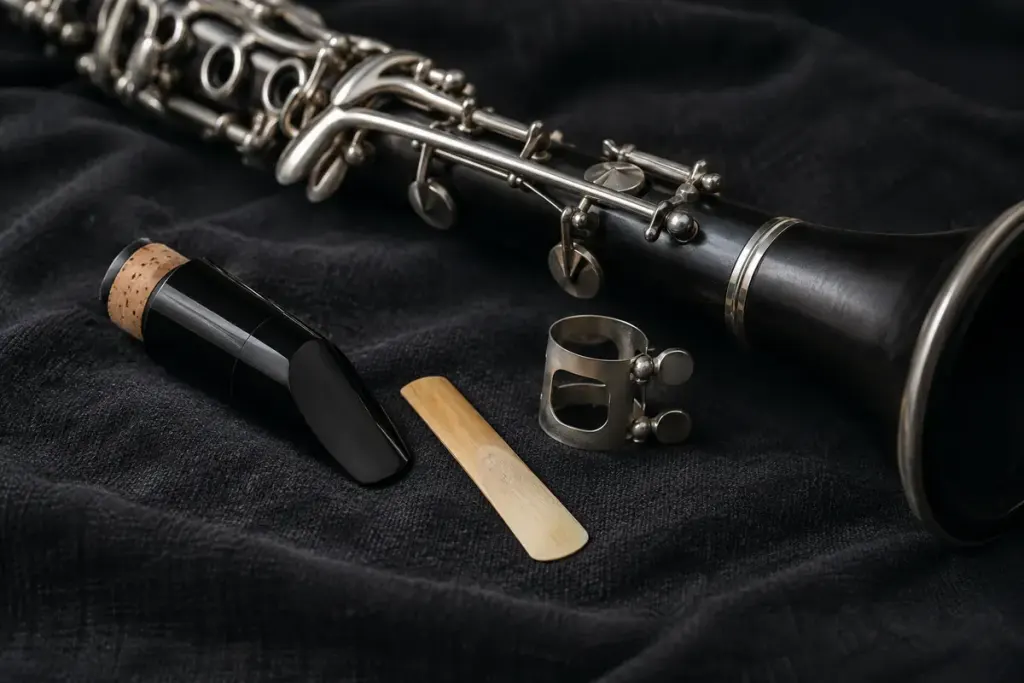
The thin piece attached to a clarinet mouthpiece looks too small to explain the sound of an entire instrument. Yet it is central to how that sound begins. A player’s breath and embouchure set the reed into vibration, interacting with the air inside the instrument.
Yamaha’s guide to the modern clarinet identifies it as a single-reed instrument and shows the reed fitted to the mouthpiece. The reed is not simply an accessory that makes an already complete sound louder. It participates in producing the oscillation that the instrument supports.
Follow the parts without dismantling an instrument
Start with a photograph or a player’s demonstration. Find the mouthpiece, the small barrel below it, the main body with its keys and the flared bell. The fingers operate holes and mechanisms that alter the acoustic conditions; the bell is not the only place sound can emerge.
Avoid imagining the air as a single parcel that travels to the bottom and comes out as one note. The sounding system involves vibrating air and resonances. For a first encounter, it is enough to connect the player’s breath, the reed and the tube, rather than treating each part as an independent sound maker.
Hear the same instrument change character
The Philharmonia’s clarinet introduction describes contrasts between its lower and higher sound and offers a player-led video. Use that resource or another clearly identified demonstration to follow one instrument across its range.
On the first listen, mark only low, middle and high passages. On a second, describe the quality in ordinary terms: rounded, bright, breathy, pointed or smooth, if those words fit what you actually hear. Keep loudness separate from pitch. A higher note is not necessarily played louder, and a softer passage is not automatically lower.
Try one comparison with your eyes away from the screen. Then watch again to see which visible movements helped or misled your first impression. A dramatic hand movement may attract attention even when the most important change is in the player’s breath or articulation.
Leave maintenance to the owner and teacher
Reeds are delicate and personal playing equipment. Looking closely does not require touching someone else’s reed, adjusting their ligature or trying their mouthpiece. If you are starting lessons, let a teacher show the fitting and care routine for your instrument.
At the next concert, listen for the clarinet’s change of colour within a phrase. The useful discovery is not a list of parts memorised before the music begins. It is a clearer connection between a small vibrating reed, a skilled player and the range of sounds reaching the room.
AI-generated editorial illustration; not a documentary photograph.